Recently I’ve been giving tours of the Art Institute of Chicago to schoolteachers that I encounter in my job as a sub. Teaching full time is hell. Subbing’s no picnic, but at least at the end of the day I loosen my tie and I’m free. I try to be useful to public school teachers by sharing my love of art with them.
A teacher asked me a while back if we could go at the end of February. He asked me sometime in early January, and I said sure. I spent about a month preparing for his personal tour of the museum. I decided as long as I’m giving tours, I may as well learn about artists I know nothing about. So, I decided we would focus on Seurat and Caillebotte. I spent all my prep periods as a sub, my downtime, just watching YouTube videos on these two Impressionist Masters.
We went to the museum last Sunday, and we spent three hours there. We looked at two paintings.
Yes, I watched a LOT of videos and I had a lot to say about these paintings.
They are not just paintings- they are absolutely icons of Impressionist art- treasures that people come from all over the world to Chicago to see.
We started with “Rainy Day In Paris” by Gustave Caillebot:
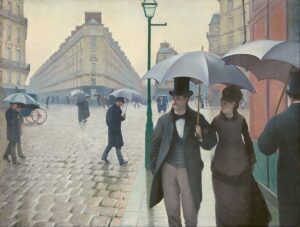
We stood in front of the Caillebotte painting- “Rainy Day In Paris”. It’s so moody, but not in a bad way. It’s not moody as in “depressing”, but rather it communicates a kind of mood or feeling. Caillebotte’s painting might be the first major painting to depict collapsible umbrellas, for they had just been invented the year before in England. Similarly, this painting might be the most important painting of the “new” Paris following its renovation by Napoleon the Third and his architectural deputy, Hausmann. Before Hausmann, Paris had been a medieval city of narrow boulevards and small houses and shacks. Hausmann demolished all the tiny streets and shanties and decreed that the streets must be wide enough for the portage of multiple carriages at a time and that all the buildings must be at least four stories high. So, that’s why everything in this painting is so clean and new.
Caillebotte used the Golden Section to great effect in his work. I don’t fully understand the Fibonacci Sequence or the Golden Section because I’m not a mathematician but you find the Golden Section everywhere in nature, from the curl of waves to the shape of clouds to the slope of mountains. It’s a certain ratio that creates a harmony which is pleasing to the eye. That’s why our eye travels in a counterclockwise spiral while looking at this painting- it draws us irresistibly inward. Until it slaps against the green streetlamp in the middle right of the canvas! Caillebotte deliberately interrupted the Golden Section ratio to make remind us that this Paris is new. The colors in the painting are so muted, they are mostly washes of black and white. That’s why the green of the streetlamp is so shocking. Apart from a little orange facade by the well-dressed couple, it is the only color in the painting. Also, green and orange are complementary- so withholding all color except for those two makes them crackle.
I love how tactile the painting is. I like how I can feel the umbrellas, the lovely blouse of the lady and the blue overcoats worn by the mysterious figures in the background. I love the slightly melancholy yet peaceful air. I also like how the painting suggests that the couple does not see the viewer, and we’re about to crash into them, with mutual exclamations of apology and surprise!
After the French Revolution, there was another revolution in 1830 and one more in 1848. But there was never another revolution after Hausmann reorganized Paris, widening the streets. In part this was a cynical military move to allow for the quick transportation of arms and men, but on the other hand the wide streets made it possible for people of different classes to socialize! In old Paris, mixing between people of different classes would have been unthinkable if not impossible! But by making transportation much easier and more centralized, people of different backgrounds could associate, hang out and people-watch. While this painting might point out the danger of atomization and human isolation which accompanies urban life, I don’t think the people here look unhappy. They are of different classes, as shown by their attire, but they are also woven together, and sharing the same space. With urbanization we get museums. Museums are a source of democratization and freedom. I’m happy I get to live so close to a great museum so I can see great paintings like Caillebotte’s.
Caillebotte’s father sold mattresses to the French army, made a killing, and then became a fabulously wealthy rentier, and died young. So his son, Gustav Caillebotte, didn’t need to work. Caillebotte was an athlete, a stamp collector, a yachtsman, a great painter, and a shrewd sponsor of other artists. He actually paid the rent for Monet’s and Renoir’s studios! He wouldn’t take money from them, but he would stop by from time to time and say “I want that painting!” And they would give it to him, and so it was win-win. He was paid with art. At his death, he had over ninety masterpieces in his collection. Renoir, his executor, followed the stipulation of Caillebotte’s will and offered the entire collection to the French state. The French government didn’t want it! They referred to Impressionism as “degenerate art!”
Renoir tried again for the next decade to GIVE the art to the state, without success. Finally wealthy American robber barons like Bartlett and Carnegie and Rockefeller started buying up all the Impressionist artists, sometimes for a song, and the silly officials finally realised they were sitting on a gold mine that was quickly being sent overseas. So, finally they took half of Caillebotte’s collection, which eventually formed the core of the future Impressionist Musee D’Orsay.
“A prophet is not honored in his own country”- how appropriate.
I did not like Caillebotte until a month ago when I started watching YouTube videos about his life and work, and I got a sense of how serious of an artist he is, and how great is his achievement. He was overshadowed by his contemporaries because he made no effort to sell his work- because he didn’t have to. Also, he was known as a collector and promoter of other artists rather than a great artist in his own right. From knowledge we acquire love.
Mozart said that the first condition of great music is that it must be pleasing to the ear. Caillebotte’s work is definitely pleasing to the eye.
The Art Institute of Chicago acquired “Paris Street Rainy Day” in 1964 and that set off a reappraisal and rediscovery of Caillebotte that continues to this very day.
After looking at the Caillebotte painting for a little over an hour, we went to the other bookend of Chicago’s Impressionist collection: Seurat’s “La Grande Jatte: Sunday Afternoon.”
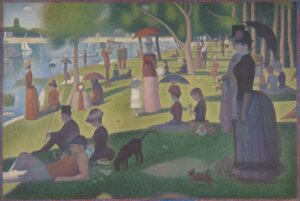
I think, like Caillebotte’s painting, Seurat’s “La Grande Jatte” is musical. Like Caillebotte, he uses the golden section to make the eye travel in an ever narrowing spiral, deeper and deeper into the painting. Also, he was a follower of the French chemist and color theorist Chevreul, who came up with the concept of complementary colors, that when placed next to each other, literally pop. Seurat said somewhere that he did not want to mix the colors of his paintings on his palette. Rather, he wanted to place his colors side by side, and let them be combined in the viewer’s eye.
He spent a full year on this painting, building up the canvas with tiny vertical brush strokes. He originally painted it with no people, and added them methodically one by one, according to an almost mathematical schema.
Then, he spent another year adding hundreds of thousands of tiny dots of pure color, in complementary patterns, rhymes of blues and oranges, networks of reds and greens.
Then, he spent another year painting an inner frame around the painting. To do this, he had to have the canvas stretched with a special device, and then he spent months painting the purple-green-blue-yellow border. He did this because he wanted a pleasing transition from the actual painting to the physical frame. He wanted to make the colors absolutely alive.
Then, for years afterwards, in subsequent paintings, he would reproduce earlier studies of “La Grande Jatte” in the background of those later paintings. For example, he would paint models posing in front of the “La Grande Jatte.” The Barnes collection in Philadelphia has the greatest example of this kind of painting-within-a-painting.
So, Seurat spent three years working on this painting, and then years more including it in other paintings!
Seurat’s father was an aloof, emotionless man who managed a factory and came home just once a week to have dinner with his family in silence. When Seurat grew up and moved out, he would come home every day to have dinner with his mother, likewise in silence. He contracted a terrible throat infection, alas, and asked his mother if he could recover at her house, with his mistress and son. His mother was shocked because she never knew that he had a lover and a child! His friends were also all shocked because he had never told any of them! He died of the throat ailment a week later, most probably it was diphtheria, and his child and his father followed him in death one week and one month later respectively.
He was only thirty-one years old! But it doesn’t feel like his career was incomplete. He created one indisputable masterpiece, “La Grande Jatte”, but many other fine and remarkable paintings. His career shows an evolution of style, discreet periods, an assimilation of available scientific knowledge of optics, as well as the clear influence of other masters like Monet and Pisarro. Interestingly, he was fascinated by Egyptian temple hieroglyphs and paintings as a child, and his figures in “La Grande Jatte”, almost all in profile, clearly show his energetic engagement with ancient Egypt.
Someone once remarked that Impressionism took an instant out of time, whereas Seurat took time out of an instant. And “La Grande Jatte” feels eternal. It is neither happy nor sad, but it testifies to Seurat’s overwhelming need to establish order and harmony in his world. I like how you can find patterns after patterns in this painting- like how the soldiers’ colors are the exact inverse of the couple on the opposite side of the painting. I like how it captures a sense of the motion of the rowers and the spinning happy little girl, but they are still at the same time they are moving. It is a remarkable achievement. I told a museum guard yesterday that every time I see “La Grande Jatte” I feel it is my first time engaging with it, and she just laughed and agreed.
I guess Caillebotte and Seurat were both fortunate in coming from wealth, and unfortunate in being misunderstood. As I touched on in my last essay, Caillebotte to this very day is controversial for daring to depict men in art, especially the homosocial world of athletes, and Seurat was accused of creating unfeeling, inimical paintings. I suppose that’s why artists have to follow their own vision. As humanity evolves, it will eventually offer gratitude to the art that helped its consciousness.
